Our experience here in St.Ives Bay taught us that small things can make a big difference. Hopefully, what we learned could be useful to your community.
But it’s important to acknowledge that the context of your community might be very different to the one we have here in Cornwall. It might be harder to speak out or more difficult to organise. There may be real consequences to protesting. It might be that your community doesn’t have the time and the resources that we had. Or maybe you’ve got different ideas about how to express your community voice.
So this isn’t a ‘how to’. It’s more ‘this worked for us and maybe it will be useful to you’.
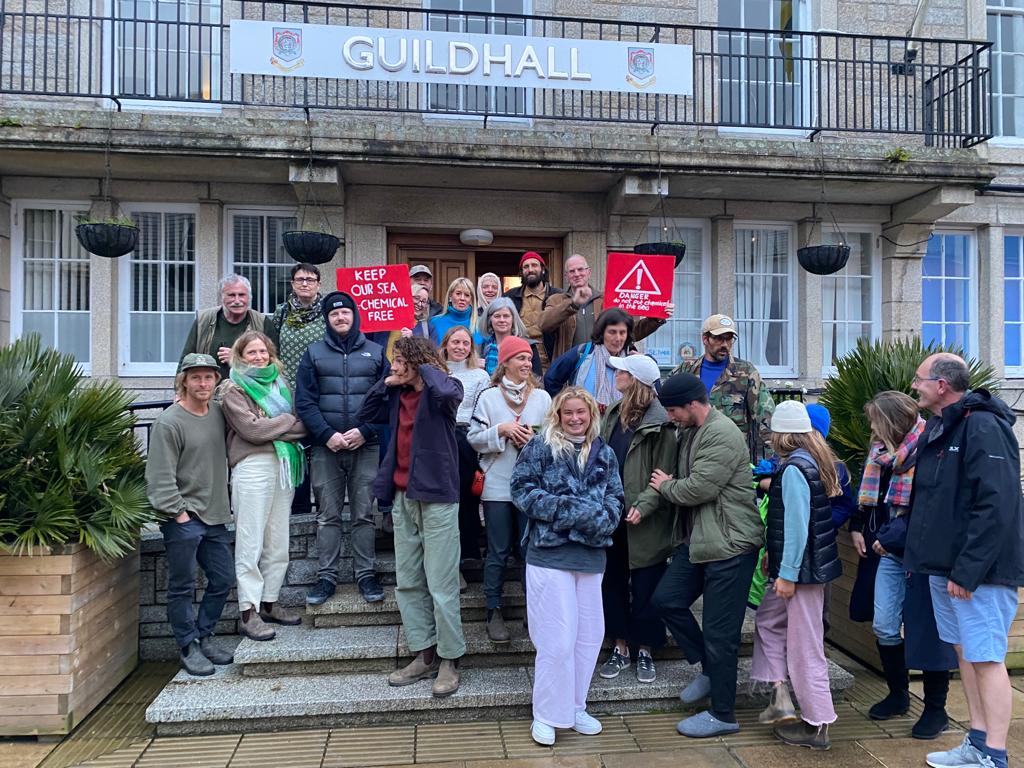
Local people at the St.Ives Town Council Meeting on 12th April 2023. This was the largest public turn out to a full council meeting in recent memory.
Here is some more detailed information:
1. KNOWLEDGE IS POWER – gather all the information you can and make someone responsible for keeping it all in a central location (like a google drive). Give trusted people access to this information . . . click on text to expand
We felt overwhelmed and insignificant when we first heard about the planned geo-engineering experiment in St.Ives Bay. It seemed like the momentum was unstoppable; the next experiment was going to happen in a matter of weeks and we had no idea what to do or who to turn to. Our only source of information was a news article and a company website. Someone found out that there were to be two public meetings and they spread the word.
We were really lucky that an experienced environmental activist (thank you Nicola Sheriff) attended the second public meeting. She had heard from people who went to the first meeting that they had failed to get proper answers from Planetary Technologies (the company who wanted to test in St.Ives Bay) and she immediately knew what to do.
Nicola took detailed notes at the meeting and emailed all the people she knew who had attended, asking them to send her the questions they’d asked and the answers they had received plus anything else of note. We are a pretty small community so a lot of people at the meeting knew each other and the email was passed around to people who had attended the first meeting too.
Nicola then collated all the information into a document – summarising the first and second meeting. This was then sent out to everyone who had contributed. These documents are still a very useful resource as they are a detailed contemporaneous record of what was said from the community perspective.
Nicola explained why this is important:
“By collating all that information, we could see straight away there were discrepancies in what people were being told. . . in the past we’ve had the experience where a community is divided because they all have different parcels of information, sometimes conflicting. As a community you have to join forces so everybody was on the same page and had access to all the information.”
From this point on – everyone in the group who met up with Planetary Technologies or spoke to them (and they were still our only point of contact) kept notes and passed these on to Nicola for out central database. It was fascinating to keep a record of what PT was saying and how the story changed. It allowed us to feel much better informed and to understand the major issues. Nicola and others also researched Planetary Technologies and the concept of geo-engineering and shared their findings with the group.
It was really important that Nicola was able to informally co-ordinate this and the rest of us could feed in and gradually formalise the process and spread the load.
2. CREATE A NETWORK – initially we had an email chain of interested people who had attended the public meetings or had useful information. This email group gradually evolved to include scientists and other experts. . . click on text to expand
The group Nicola informally set up corresponded via email. It was a group of about 20 – a combination of local people and others further afield who were interested, knowledgeable or both. We were able to reach out to a number of scientists who could give us an independent perspective on the science and context of the proposed experiment.
This knowledge base allowed the group to collaborate around the questions we asked PT and not to duplicate what we asked. Having scientists in the group also allowed us to better understand and scrutinise the answers we got. As we gathered more information the issues became clearer and we were able to communicate these to one another and our wider circles. This informal group eventually became the Cornwall Carbon Scrutiny Group.
A very important connection we made was with Sue Sayer MBE, of the Seal Research Trust, who was concerned about the impact of chemical testing. She was an important voice on the Cornwall Carbon Scrutiny Group and she also liaised with Keep Our Sea Chemical Free. As part of her record keeping – Sue kept a meticulous account of all her meetings, interviews conversations and research. This has proved extremely useful during our separate but linked effort to hold Planetary Technologies to account. Check out Sue’s brilliant google doc here.
3. FORM A GRASS ROOTS PROTEST GROUP – this group was made up of people right in the thick of it. Specifically those living around St.Ives Bay. We found that they had the strongest response to Planetary’s presence. After all, we interact with St.Ives Bay every day . . . click on text to expand
We needed this uber-local group to support one another and also to become the face of our community response. Initially we came together as a group of residents living around the bay. We’d chatted in the street; at the orchard, in the sea, at meetings for other local projects, and we were all shocked and confused. Senara Wilson got a small group together on WhatsApp and asked everyone to spread the word about an in-person meeting upstairs at St.Ives Art Club.
There were about 15 of us in the room and we all knew each other from our day to day lives. We sat in a circle and talked about how we felt and what we should do. Eventually we decided to organise a ‘protest and information day’ to help our wider community understand what was happening and to demand that we be part of the conversation.
People in the wider network had been uneasy about the idea of a protest. Was it too confrontational? Too negative? But the people in that room shared a profound feeling of outrage – that a test had already happened in the sea directly outside the window of the room in which we were sitting, and that another was planned with no apparent oversight. We needed to come together to express our shock and to support one another. We also decided to make the protest as inclusive and informative and impactful as we possibly could. We went away to think about what we should call ourselves and that’s when Camilla Dixon came up with the name KEEP OUR SEA CHEMCIAL FREE (KOSCF) which won hands down on the WhatsApp vote. We set up on Facebook and Instagram and immediately saw the strength of opinion.
4. OUTREACH – this is all about connecting with other people and organisations, giving them our community perspective and learning about theirs. It’s amazing how many connections fan out from a small group and how many people have skills they are happy to share. . . click on text to expand
Until this point – there had only been one source of information. Planetary Technologies – the company planning a second experiment in St.Ives Bay. They were obviously entirely positive about their plans and the potential impacts and they were not being held to account by independent scientists. This shaped our initial community response – we decided to call for 3 things.
1. More time to interrogate what was proposed.
2. An environmental impact assessment.
3. A proper public consultation.
Letter writing proved important – even though at the beginning we had no idea who to write to and often letters bounced back with a corporate holding response. Sue Sayer of the Seal Research Trust proved brilliant at writing letters to the Environment Agency (EA one of the UK Regulators) and others connected to the experiment such as South West Water. Sue learned the power of the open letter – she was pretty much ignored until she publicised her letters by including all relevant parties.
“Open letters make a useful option when previous correspondence has not been responded to…the open letter (to the EA) was clearly labelled as such and had a few key people from other organisations and politicians copied in and lot of press blind copied” (Sue Sayer)
Eventually Sue’s local reputation and tenacity resulted in a number of face to face meeting with the Environment Agency and South West Water. In these meetings she and the scientists she bought with her were able to ask questions and offer important information and perspectives. Meetings and letters were always polite and collaborative allowing longer term relationships to form.
A contact informed us that the UN wanted to hear from communities impacted by geo-engineering – so KOSCF wrote to them too. (here is the letter from KOSCF to the UN plus the letter to the EA which we attached). We also used our connections with the local press to help provide information, quotes and photographs. One of our members James Warburton – ‘Warbey’ – is a brilliant photographer with a deep knowledge and connection to St.Ives Bay. He allowed us to use his beautiful images any time we wanted, so KOSCF had a great sense of identity from the start.
Our Town Councils didn’t have any power over the experiment but we felt it was important that they have a say. Senara who was a town councillor, introduced a motion to St. Ives Town Council who debated the experiment. An unprecedented number of locals came along to listen. Hayle Town Council also debated the proposed experiment. We also connected with some useful NGO’s who were able to give us a global perspective on geo-engineering. All these connections remain very important in our on-going work to protect the bay and to understand the impacts of geo-engineering experiments.
Two brand new community groups formed due to the threat of chemical testing in St. Ives Bay. These groups were independent but worked with each other closely.
1. KEEP OUR SEA CHEMICAL FREE (KOSCF)
2. THE CORNWALL CARBON SCRUTINY GROUP (CCSG)
The other group instrumental in holding Planetary Technologies to account is the CORNWALL SEAL GROUP RESEARCH TRUST (CSGRT). This multi award winning conservation charity has been working for decades to survey and study the globally rare grey seals which live in St.Ives Bay. The group worked closely with KOSCF and CCSG but is a totally separate and independent body.
 KEEP OUR SEA CHEMICAL FREE