Ocean Alkalinity Enhancement
The concept sounds so great. Add alkalinity to the ocean and improve its capacity to do what it already does.
Job done.
But our experiences in St.Ives Bay showed us that the reality is a lot more complex.
And much less certain.
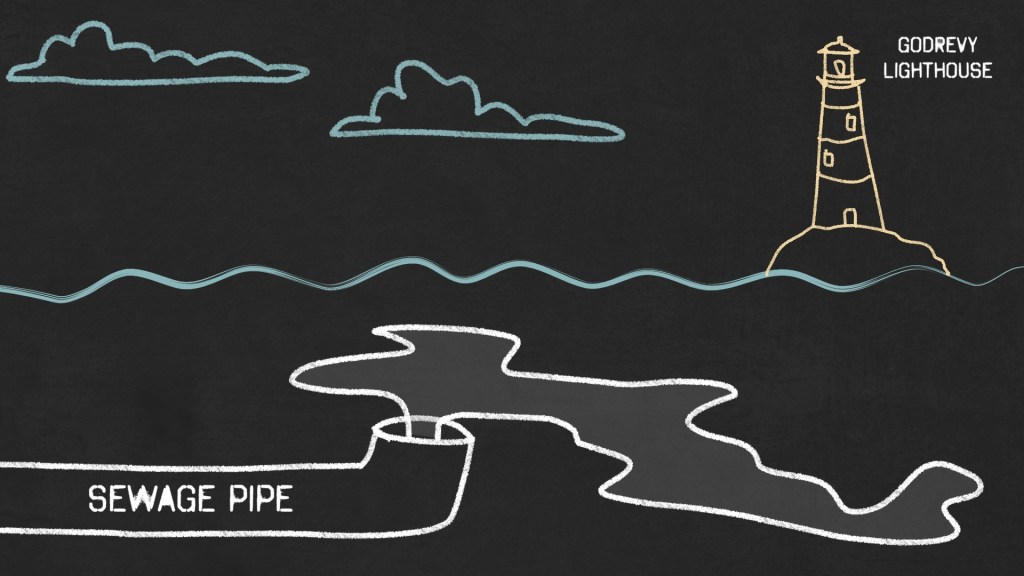
Areas of uncertainty and potential risk
1. Impacts on the marine ecosystems? (click to expand)
This was a big one for us. Planetary Technologies (PT), the Canadian company who wanted to keep experimenting in The Bay, kept reassuring us. Their messaging was this, there was absolutely no need for us to worry, they had everything sorted. The experiment was way too small to have any adverse impacts. If they noticed any, they would just stop. They had scientists on the team and the science was simple.
It was hard to question such certainty. And PT seemed to have all the authorities on their side as they were about to embark on their second test.
But we soon noticed that it didn’t add up.
PT didn’t know about our remarkable grey seal population, one of the rarest seal species in the world. Or about historic mine toxins that are trapped in the sediment of St. Ives Bay. PT confidently predicted how the Magnesium Hydroxide would disperse but how much did they really understand our currents and tides?
It’s very easy to underestimate the wealth of knowledge held by a local population … and to overestimate the knowledge of companies who are very keen to find a location to test their version of ocean alkalinity enhancement.
Our fishermen knew every species of fish, lobster and crab. Our swimmers and divers knew the seaweeds and crustaceans. Our surfers knew about the impact of storms and tides. Our marine groups tracked the whales, dolphins and birds that visited.
It became obvious that PT didn’t really understand the marine ecosystem of St.Ives Bay or the community that interacted with it every day.
2. Design of experiment? (click to expand)
Over the many months we spent trying to delve into the design of the experiment, several things stood out to us. We were lucky to have scientists in our community who could be specific about some of these problems.
* Lack of clarity about the second proposed experiment. Basic things like how much alkalinity was to be used and the dosage rate. The information we got on this was contradictory and confusing – one person was told 400 tonnes, someone else 1000 tonnes. And then after the protest, PT reduced the proposed dosage rates to respond to public opinion. But what did this mean? It seemed a strange way to design an experiment. It seemed like PT were desperate to make sure the test happened – and less interested in the test itself. Our local community wanted rigorous science to be applied – and we needed independent experts to make sure this was the case.
* Incorrect information – PT told locals that the experiment would change the alkalinity of the bay and help the local marine ecosystem. The head of PT – Mike Kelland, told us about an experiment that used Sodium Hydroxide in an Australian coral reef that had a positive impact on coral growth. But then PT told us that the alkalinity would disperse so quickly in St.Ives Bay that there would be no impact on alkalinity at all.
* Inadequate baseline – we realised that there was no proper understanding of existing conditions in The Bay. The two days of baseline monitoring carried out by PT in May 2023 just wasn’t sufficient and they agreed with us about this (this is our conversation – around time 54.25)
* Inappropriate control sites that were very different to the experiment site. (this is our conversation – around time 34.50)
* Impact on species – we felt there needed to be a much better understanding of the potential impact on different species (something the Environment Agency would also ask for in late 2023 – see page 7 and 8 of this report)
* Risk of precipitation – this is something scientists like Sue Sayer from the Seal Research Trust had been concerned about (see this paper). We were concerned that reactions might result in toxic precipitation or seed a high pH that would negate the experiment and have adverse impacts. Subsequently The Water Research Centre Report said there was a medium risk of precipitation.
* Possibility of alkalinity bonding with existing heavy metals in The Bay. We have a long history of mine waste being deposited into St.Ives Bay. This is something PT were not aware of. PT were concerned about the higher than expected mercury levels they found in the bay when they did their baseline survey.
3. Monitoring, reporting and verifying Carbon Dioxide Removal (MRV) (click to expand)
This is a big one for Ocean Alkalinity Enhancement. Turns out there is no physical way of measuring that the process is actually working. You can verify Carbon Dioxide absorption in laboratory conditions but not when alkalinity is dispersed in the open ocean. That’s why companies like PT are pushing hard for bodies like the UN to recognise modelling as a way of verifying C02 removal. This means, modelling what they think should be happening as opposed to physically proving it. This is especially contentious in complex and rapidly changing ocean systems which are not fully understood.
5. Scaling up (click to expand)
Planetary Technologies made some startling claims about how quickly they wanted to grow during our early community meetings. They stated that they were aiming for 1 Gigatonne (one billion tonnes – 1,000,000,000)annual C02 removal by 2035. PT called this ambition ‘insane’ but stuck to it. What were the ramifications for St. Ives Bay? Did this mean an ‘insanely’ quick scaling up operation with an ‘insane’ amount of Magnesium Hydroxide eventually being discharged into our local sea?
The scale and speed of such scaling up immediately caused disquiet among attendees of the meetings – one of them did a back of the envelope calculation that showed it was beyond unrealistic. Tech start ups have a history of over exaggerating and overpromising but this made us feel like we were dealing with a company that wasn’t being straight with us or itself.
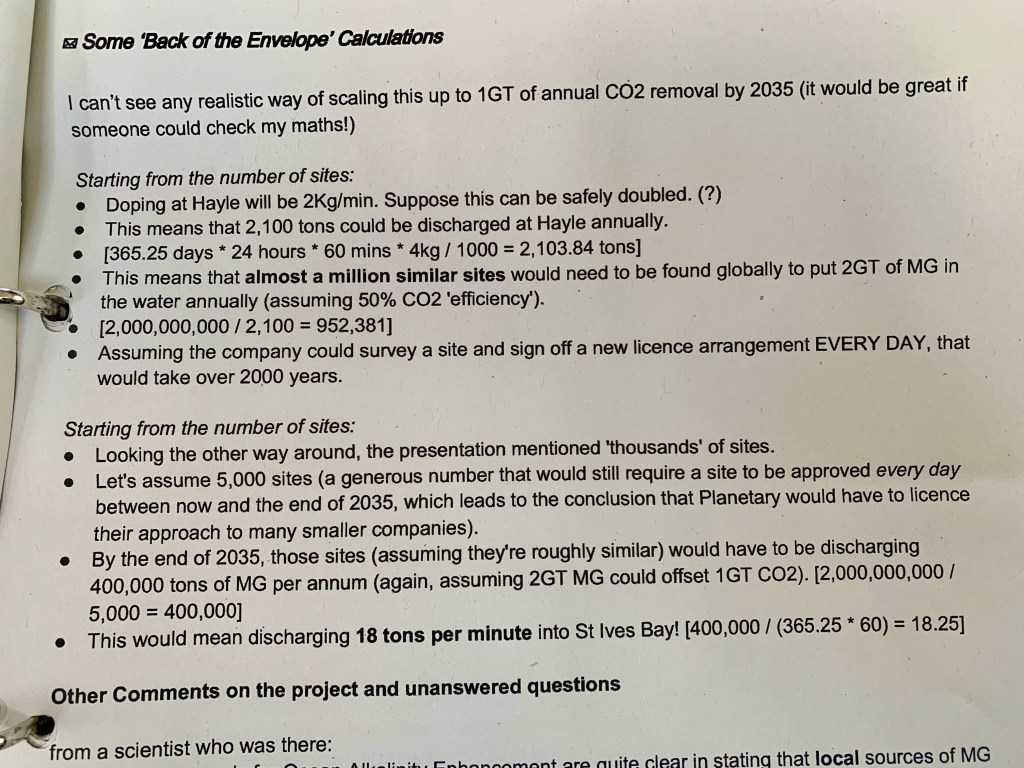
PT didn’t budge from their scaling up claims for some time but they did in the end update their website agreeing that their previous ambitions were unrealistic and setting a new goal of 1GT by 2045.
There are other issues with scaling up – see the BIG QUESTION
4. How is the experiment financed? (click to expand)
This was confusingly opaque during the community’s early meetings with Planetary Technologies. They were keen to underplay the fact that they were a for-profit company and it took us a while to find out how they were funded. Basically they are a tech start up and they raise money from private investors and grants. We learned that they had already sold their own version of carbon credits to Shopify. At this point, Elon Musk’s X prize had given them a million dollars and our own UK government had supported PT with £250,000 to help them find a location for testing (which ended up being St.Ives Bay).
This is what Shopify said when they first got involved with PT.
“There’s a ton of research showing that we need to leverage the ocean as the world’s largest carbon sink ”
Basically – Planetary Technolgies monetised St.Ives Bay by selling a form of carbon credit to Shopify on the basis of the experiment they carried out in September 2022 and the one planned for June 2023.
We don’t know what PT’s deal with South West Water (SWW) is/was and but we were eventually told that there was no financial arrangement during the experiment stage. We understood however that they would share carbon credit profits in the future.
Plantary Technoloiges are still selling carbon credits that they have invented for their process. Under pressure about the ethics of selling carbon credits during field trials, they did eventually agree not to sell carbon credits for future experiments in St.Ives Bay. But it’s tricky to disentangle a private company’s funding model and isolate one area of its business.
Carbon Credits – are controversial. They may actually add to global heating and have negative impacts on ecosystems and communities.
 KEEP OUR SEA CHEMICAL FREE