A protest can be loads of different things – it depends on the context. You may have different ways of expressing your community voice that work better for you. Public protests might be difficult or dangerous in your community. It may be unsafe for some people to take the lead or even attend protests.
Here is what worked in our context – a small coastal town in Cornwall, UK.
1. FORM AN ORGANISING COMMITTEE – Get a small group together and decide what you want your protest to be…(click to expand)
This is too much for one person so an organising committee is a good idea. Also it helps to bounce ideas off each other and then to have clear messaging for the wider group. In our group of about seven, everyone had useful skills and was able to take responsibility for a different aspect of the protest. We had one person who was the main point of contact for everything.
Decide on a date and give yourself some time – we had a 4 weeks run up to our first protest so we needed to get the date sorted and in people’s diaries. Run the date by as many key people as you can. It’s never going to be perfect for everyone and at some point you just have to go for it. Once you’ve put out the date, it’s best to stick to it. So think about it hard first.
Organisie Publicity: an EventBrite page (or something similar) / press releases / social media posts / posters / providing content / connecting with journalists and the media. It’s a good idea to find a few people to be media spokespeople – preferably spanning a range of ages. In our case we made sure our spokespeople lived around St.Ives Bay.
Networks: use existing networks and contacts to reach out. In smaller communities, a few trusted people will have loads of contacts and connections. This is how we connected with Sue from The Seal Research Trust – we really wanted someone with a science background to give a speech at the protest. One of our organising group knew Sue and reached out to her. The surf/sea community got passionately involved and a lot of that was down to Harris, one of our key members who runs the surf school on Porthmeor Beach in St.Ives. The fishing / working boat community also joined our second protest because some key respected people were part of our wider network.
Legs on the ground: putting posters up / transporting / making flags / gathering equipment and people / odd jobs
Let creativity flow: no need to micromanage once the main messaging is clear – we ended up with some beautifully sewn banners that a volunteer at the orchard made for us. She just decided to do it and her banners have been an iconic part of all of our protests ever since.
2. HOLD THE VISION – We were very clear in what we wanted our protest to be and that meant we could be focused about what was needed and precise in our messaging…(click to expand)
This might seem a bit fluffy – but actually it’s really important. We found that it allowed us to be very clear with participants and volunteers. Often other groups and individuals want to piggyback on a protest to publicise their own (worthy) cause. But this can make things confusing and disparate. Our decision was to focus purely on the issue of geo-engineering in St.Ives Bay.
It’s not about being inflexible – in fact, just one day before our second ‘Swim for the Sea’ protest, we changed location as we’d been advised that migrating birds were using our protest site. Initially there might be a bit of a defensive reflex cause ‘damn .. . we’ve already organised all the maps and told everyone where to be.’ But it’s good to take a breath and think about the vision, of course the last thing we want to do is impact migrating birds and we can find a nearby gathering point and re-send out all the coms. Holding the vision still allows room for questions and creativity and change. But these things happen within the parameters you have decided for your protest.
Our vision for the protests in St.Ives Bay were:
Community Focus – we wanted to talk about what brought us together rather than what divides us. So we asked people to come along as a member of the community rather than representing any environmental group / political party etc. This made our protests accessible to everyone in the community and meant a broader base of people felt welcome. People weren’t arriving to see a flag from a political party they didn’t like, or an environmental group they found extreme. All our speakers came from the local community – talking about our understanding of what was happening.
A platform for young people – we managed to achieve this on our first protest and it felt really important. The speeches and poem read out by our three younger contributors had a big impact. We didn’t do so well on the second protest – the youngsters we reached out to weren’t around or up for it. But it remains something we want to work towards.
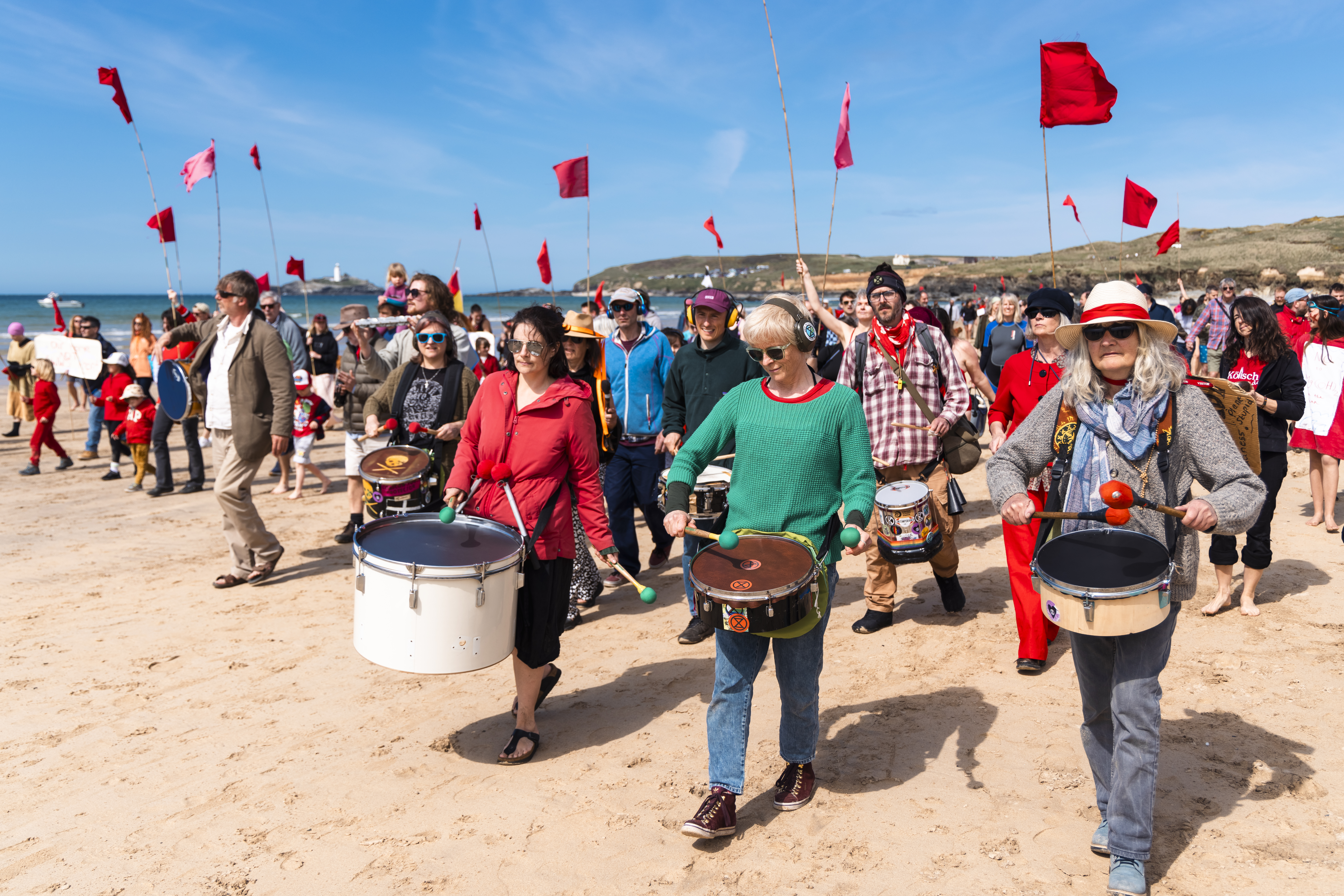
Non-commercial – we didn’t want to print a load of signs or make yet more T shirts to add to a landfill site down the line. So we asked people to make their own signs and to wear red. A group of us started thinking about this in 2020 during Covid when we set up No Going Back Sunday’s There’s something about the act of thinking about what we want to say and then physically writing it on a bit of old cardboard – that is transformational. It allows us to crystallise what we are thinking and then embody it. Of course not everybody got around to making a sign – but those that didn’t got to enjoy the creativity and humour of those that did. And it’s a great way to start a conversation.
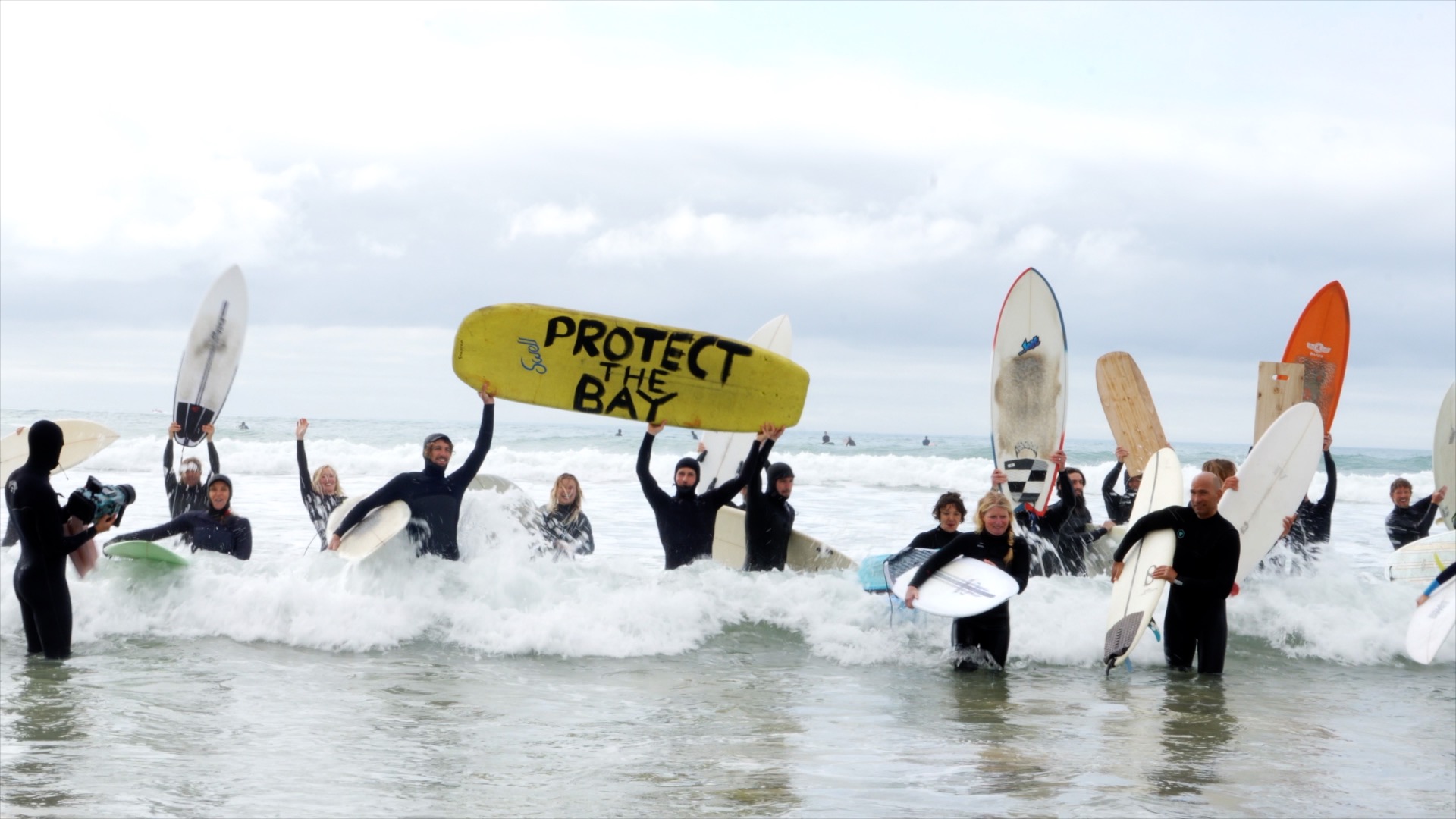
A place that matters – we decided to protest in and around St.Ives Bay because that’s what we were trying to protect. Sometimes it makes sense to travel to a company headquarters or a different location. But we decided our community protest would be rooted in place, our place that we love. Both our protests ended up with loads of people in the sea.
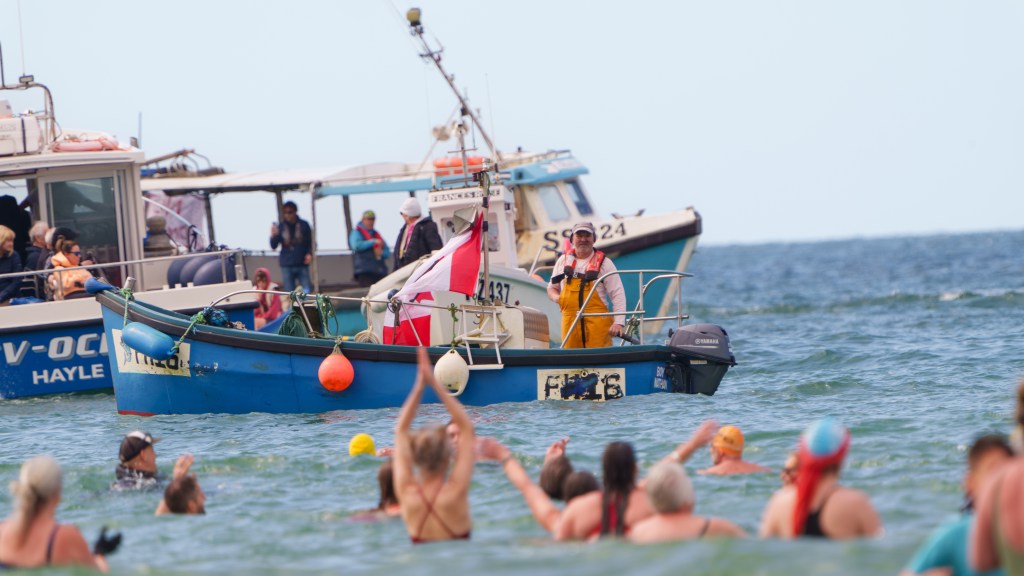
Visually striking – for us it was important to get media coverage. We knew that the locations we chose would be great for photos. We decided to use red as our colour – mainly because we had loads of red flags left over from a previous protest (made in a friend’s garage with bamboo poles and old red material). We also knew that red looked beautiful against the blue sea. We used red in our publicity material too – linking with the idea of an emergency. We also tried to come up with something that was fun for participants but also visually striking. Our paddle out was incredible to be a part of but also looked amazing in the photos. Our mass swim was raucous and joyful especially when combined with a fleet of local boats blowing horns.
Legal – We decided that our protests would be peaceful and law abiding. Lots of local people hadn’t been on a protest before and we wanted the atmosphere to be friendly, informative and safe.
Make it fun – We are talking about important issues but gathering together is empowering and joyful and fun. For many people, it was their first protest and we wanted to make sure they enjoyed it. At our protests we had some or all of the following: live music, a samba band, a mass swim, surfing, a paddle out, face paint, hooting boats, flags to wave . . .
3. SAFETY – think about what is needed to keep people safe. It’s a good idea to write a simple document outlining your safety plans and solutions. You can pass it around to the organising committee and volunteers…(click to expand)
We put stacks of information on the EventBrite invite including loads of safety information and suggestions. At our protests we had Stewards in high viz jackets who knew what was going on and could help and direct people. We also informed the police (luckily we know our local police officer well). Beacause they knew the organisers, the local police reassured their superiors that it would be a peaceful protest. They were also able to help with traffic management when loads of people arrived for the first protest. We had a first aid kit and identified people with first aid skills. We also informed the medically trained lifeguards of what we were planning. We gave a safety talk before entering the sea put safety advice on our coms.
4. TO ASK OR NOT TO ASK?
This really depends on where you are gathering. For us it was easier to just go ahead with our protests as they were in public spaces and we were pretty sure nobody would complain…(click to expand)
This is always a subtle issue – sometimes, asking causes way more complications, questions and the possibility of an outright no. We knew that authorities were not particularly involved with the bit of land and beach we picked – they were well used by the public and not overtly controlled by a specific body (eg. the National Trust) We also knew we’d be careful and respectful and pick up litter.

Here are some examples of speeches and other protest resources;
Sunday 16th April 2023 – Protest and Information Day
Sunday 21st April 2024 – Swim for the Sea
 KEEP OUR SEA CHEMICAL FREE